
For anyone undertaking research into their family tree in the UK, the term 'scholar' will be familiar. This was the term often provided for children in the 'rank, profession or occupation' column on census enumerations and showed that they were receiving and education. However, how much of an education and where this took place were not specified on the form.
Prior to the first Elementary Education Act of 1870, which sought to provide a standardised education for those age 5-12 (although it did not become a legal requirement to send children to school until 1876), schooling was inconsistently available across the country. It may have been that the only education provided was via a church Sunday School or other charitable foundation. Alternatively, children may have had access to a local National School. These developed from the early nineteenth century onwards, based on Church of England teachings, whilst Ragged Schools were introduced in poor urban areas, often providing food and clothing as well as education. Other non-conformist schools existed, many of which were run on 'monitorial' which relied on using pupil-teachers to make education cost effective.
Thus, prior to the Education Acts which were passed from 1870 onwards, it is possible to find children with occupations provided in a census with very young children being found bringing in an income to the home.
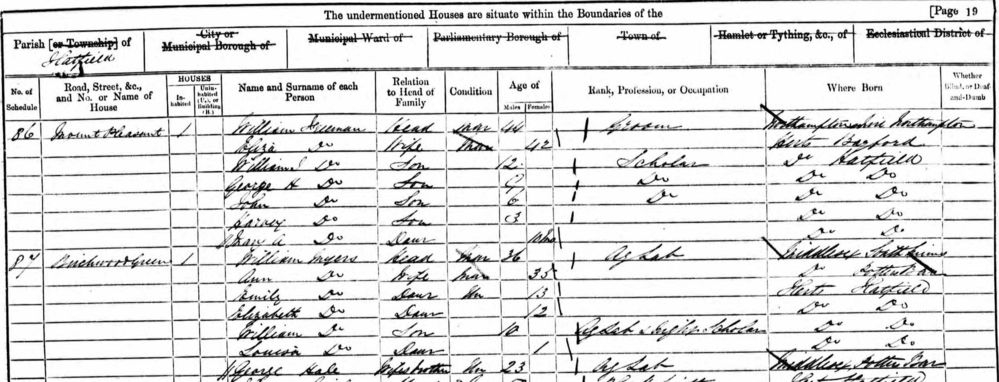
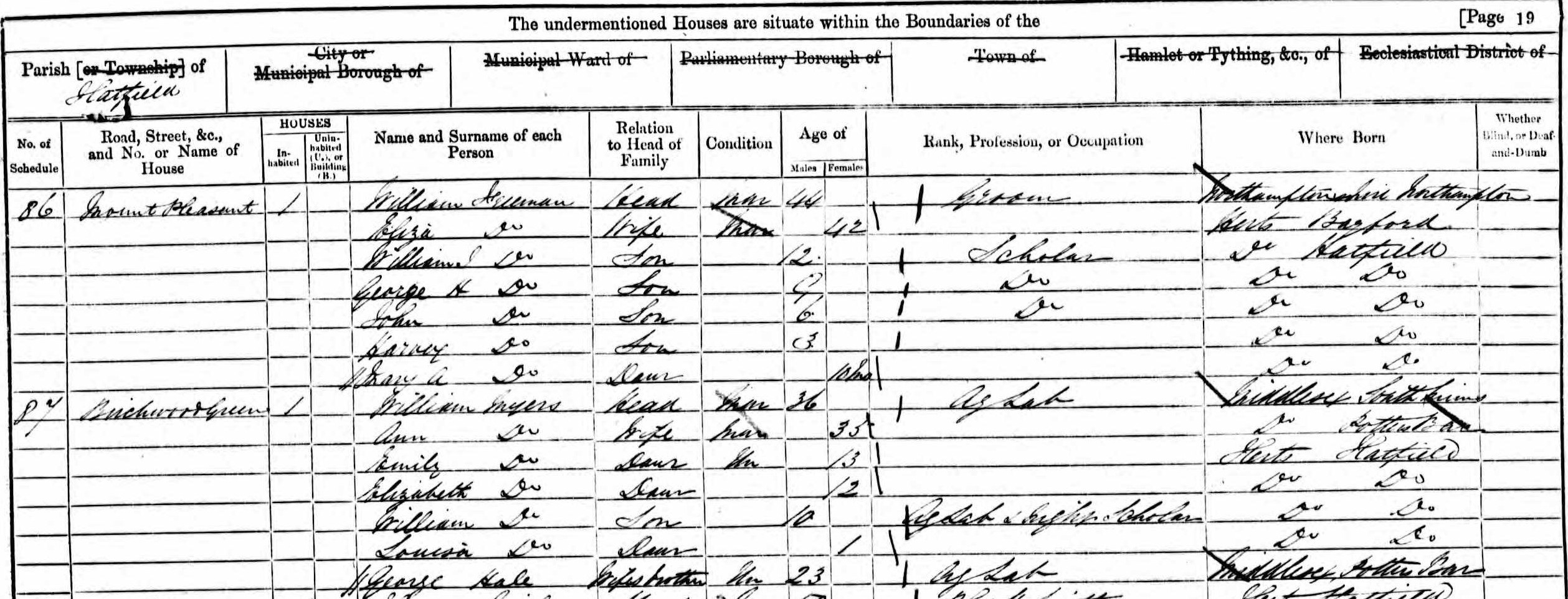
In this example from rural Hertfordshire in 1861 a more unusual occupation is given - it appears that young William Myers, then just 10 years old, was both working as an agricultural labourer whilst also receiving an education. His occupation appeared to read 'ag lab & higher scholar.' It is unusual to see more than occupation given in a census, particularly for a child.
Whilst various schools have existed in Hatfield since the 18th century, it is likely that William attended the National School at London Road in Hatfield, which opened in 1850. After 1870, Board Schools were introduced, and from 1902 school provision was taken over by Local Education Authorities.