

PRC/32/56/35
Historic probate records are invaluable for family history research because they often provide detailed evidence of family relationships that cannot be found elsewhere. Wills, probate grants, letters of administration, and estate inventories can identify spouses, children, siblings, and other relatives, helping researchers confirm family connections and distinguish between individuals with the same name. They can also reveal dates of death, places of residence, occupations, wealth, property, and personal possessions, in turn showing an ancestor's social status. In addition, probate records may fill gaps where birth, marriage, or death records are missing, making them one of the richest and most reliable sources for tracing family histories.
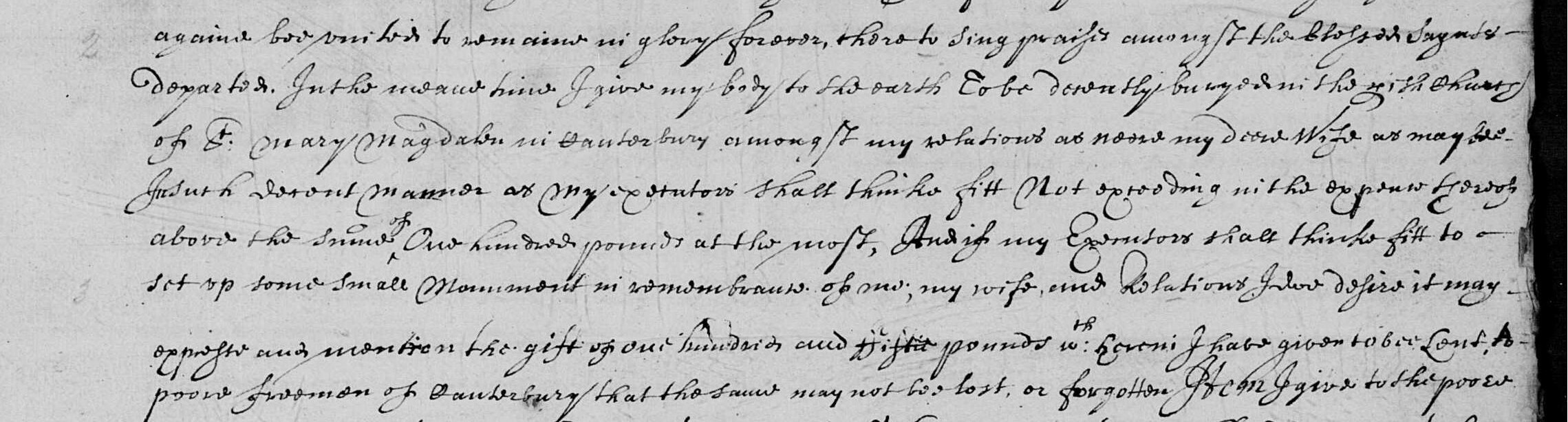
Wills can also provide other details, including where the testator wished to be buried. Often the terminology is simply along the lines of '...to be be decently buried at the discretion of the executor' but sometimes the testator has more fixed views. In the example given above, the following is stated:
...I give my body to the earth to be decently buryed in the p[ar]ish church
of St Mary Magdalen in Canterbury amongst my relations as neere my deare wife as may be
In such decent manner as my executors shall thinke fitt not exceeding withe expenses thereof
above the summe of One Hundred pounds at the most.
Here it is clear that the testator has very clear instructions on both where he wished to be buried, but also how much his burial and funeral should cost. If you're struggling to find an ancestor's will or place of burial, contact us today to find out how our team of professional researchers can help with your research.