

In September 1752, the Julian Calendar was replaced by the Gregorian Calendar in England, Wales and Ireland (Scotland had already adopted it some years earlier, in 1600). The main difference in Calendars was that the year officially began on 1st January in the 'New Style' Gregorian Calendar, whilst the 'Old Style' Julian Calendar began the year on 25th March, being Lady Day.
For genealogists it is therefore important to give both the 'New Style' and 'Old Style' dates when recording events which occurred within the first three months of the year prior to 1752. A baptism taking place on 20th February 1750 would thus be recorded as 20th February 1750/1 - historians call this 'Double Dating.'
If 'Double Dating' is not undertaken thoroughly, then it could look like a burial preceded a baptism, or a will could appear to be proved before the death of the testator. For example, if the child baptised on 20th February 1750/1 was buried the following 25th January, then this should be recorded as 25th January 1751/2. If not, and simply January 1751 is recorded, then matters become confusing!
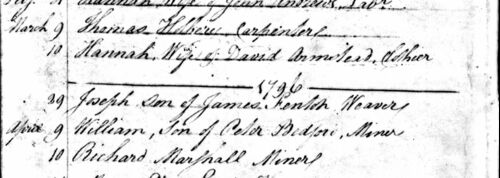
But what if the parish clerk simply ignored the introduction of this new Calendar? This appears to be the case in the parish of East Ardsley in the West Riding of Yorkshire, where not only did the register continue to start the New Year after 25th March in 1752, but this continued all the way up to the year 1811. This March split in the register is shown here for the year 1796, over 40 years since the legislation was passed.
George Rose's Act of 1812 meant that pre-printed parish registers were introduced from January 1813, and no further evidence of 'Double Dating' has been noted at East Ardsley after this time. But clearly the clerks of this parish chose to hold on to the old Julian Calendar for many decades after the Gregorian Calendar was introduced.