
After Hardwicke's Marriage Act passed in 1753, pre-printed marriage registers were introduced into Anglican churches from 1754 onwards. As well as this, every marriage was required to take place after the calling of the banns in each party's home parish for three weeks prior to the wedding, or by obtaining of a marriage licence. Whilst the merits of looking at the documentation produced for marriage licences is well known for family historians, it is also worth checking out the banns register where it survives.
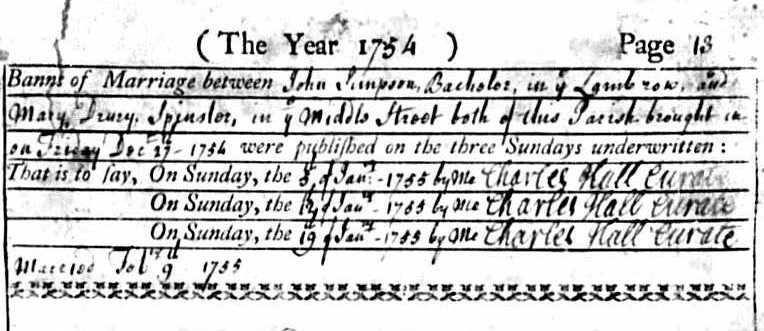
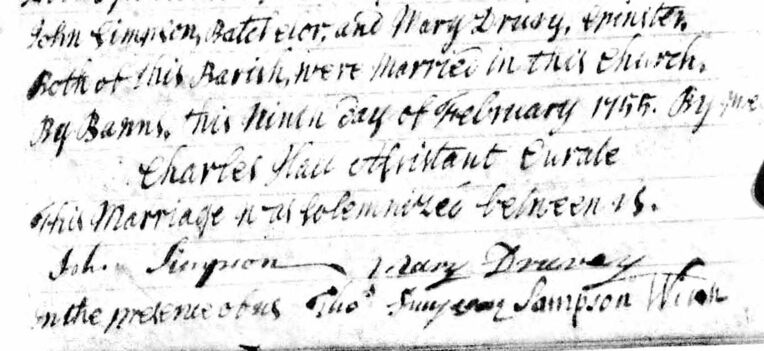
Research this week led to the banns registers of Great Yarmouth, Norfolk, in the period immediately after this Act was introduced. As well as recording the names of each party, in that period the clerk also chose to provide the precise street address at which the couple were living. This detail was then omitted by the clerk who wrote up the subsequent marriage record. This is clearly demonstrated with the marriage of John Simpson and Mary Drury, whose banns were called on the 5th, 12th and 19th January 1755, and who subsequently married on 9th February. The banns and register entries below show that their residence at Lamb Row and Middle Street respectively is provided on the banns register, but is omitted from the original register.
So it is always worth checking the banns register, to see whether any alternative information is given on a couple!